

Better-Exceptions

- package: https://pypi.org/project/better-exceptions/
docs(see source)- source: https://github.com/Qix-/better-exceptions
Library README scraped 2024-03-11
better-exceptions 
Pretty and more helpful exceptions in Python, automatically.

Usage
Install better_exceptions via pip:
pip install better_exceptionsAnd set the BETTER_EXCEPTIONS environment variable to any value:
export BETTER_EXCEPTIONS=1  # Linux / OSX
setx BETTER_EXCEPTIONS 1    # Windows
That's it!
Python REPL (Interactive Shell)
In order to use better_exceptions in the Python REPL, first install the package (as instructed above) and run:
$ python -m better_exceptions
Type "help", "copyright", "credits" or "license" for more information.
(BetterExceptionsConsole)
>>>
in order to drop into a better_exceptions-enabled Python interactive shell.
Advanced Usage
If you want to allow the entirety of values to be outputted instead of being truncated to a certain amount of characters:
import better_exceptions
better_exceptions.MAX_LENGTH = None
While using better_exceptions in production, do not forget to unset the BETTER_EXCEPTIONS variable to avoid leaking sensitive data in your logs.
Use with unittest
If you want to use better_exceptions to format unittest's exception output, you can use the monkey patch below:
import sys
import unittest
import better_exceptions

def patch(self, err, test):
    lines = better_exceptions.format_exception(*err)
    if sys.version_info[0] == 2:
        return u"".join(lines).encode("utf-8")
    return "".join(lines)

unittest.result.TestResult._exc_info_to_string = patch
Note that this uses an undocumented method override, so it is not guaranteed to work on all platforms or versions of Python.
Django Usage
In settings.py, add your new class to the MIDDLEWARE setting and update your logging configuration:
# ...

MIDDLEWARE = [
    # ...
    "better_exceptions.integrations.django.BetterExceptionsMiddleware",
]

# ...

from better_exceptions.integrations.django import skip_errors_filter

# if you don't want to override LOGGING because you want to change the default,
# you can vendor Django's default logging configuration and update it for
# better-exceptions. the default for Django 3.1.4 can be found here:
# https://github.com/django/django/blob/3.1.4/django/utils/log.py#L13-L63
LOGGING = {
    'version': 1,
    'disable_existing_loggers': False,
    'filters': {
        'skip_errors': {
            '()': 'django.utils.log.CallbackFilter',
            'callback': skip_errors_filter,
        }
    },
    'handlers': {
        'console': {
            'level': 'INFO',
            # without the 'filters' key, Django will log errors twice:
            # one time from better-exceptions and one time from Django.
            # with the 'skip_errors' filter, we remove the repeat log
            # from Django, which is unformatted.
            'filters': ['skip_errors'],
            'class': 'logging.StreamHandler',
        }
    },
    'loggers': {
        'django': {
            'handlers': [
                'console',
            ],
        }
    }
}
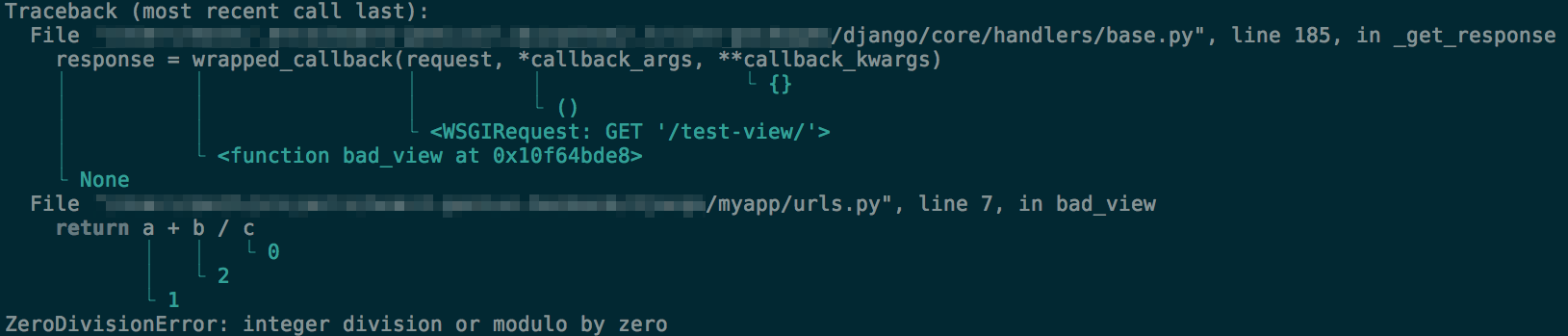
example output:
Troubleshooting
If you do not see beautiful exceptions, first make sure that the environment variable does exist. You can try echo $BETTER_EXCEPTIONS (Linux / OSX) or echo %BETTER_EXCEPTIONS% (Windows). On Linux and OSX, the export command does not add the variable permanently, you will probably need to edit the ~/.profile file to make it persistent. On Windows, you need to open a new terminal after the setx command.
Check that there is no conflict with another library, and that the sys.excepthook function has been correctly replaced with the better_exceptions's one. Sometimes other components can set up their own exception handlers, such as the python3-apport Ubuntu package that you may need to uninstall.
Make sure that you have not inadvertently deleted the better_exceptions_hook.pth file that should be in the same place as the better_exceptions folder where all of your Python packages are installed. Otherwise, try re-installing better_exceptions.
You can also try to manually activate the hook by adding import better_exceptions; better_exceptions.hook() at the beginning of your script.
Finally, if you still can not get this module to work, open a new issue by describing your problem precisely and detailing your configuration (Python and better_exceptions versions, OS, code snippet, interpreter, etc.) so that we can reproduce the bug you are experiencing.
License
Copyright © 2017, Josh Junon. Licensed under the MIT license.